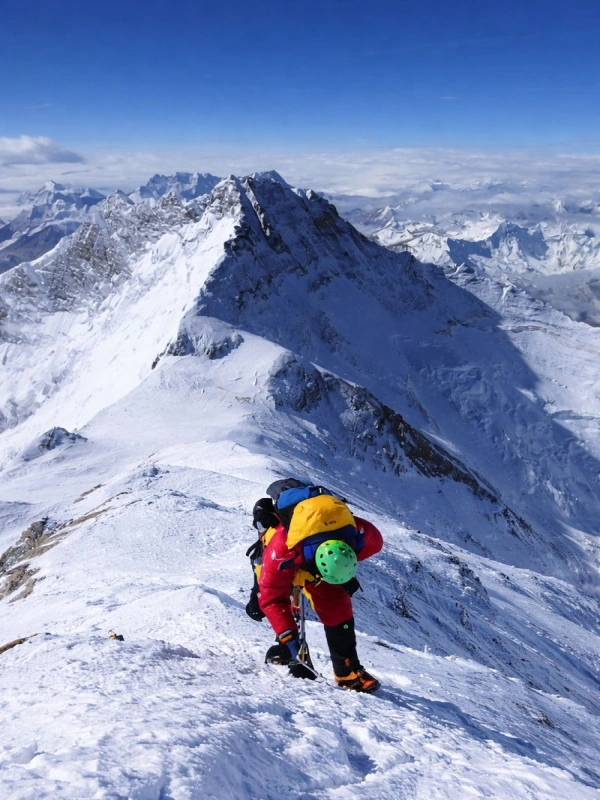
The expedition begins in Kathmandu before flying to Lukla and trekking through the Khumbu Valley to establish Base Camp at 5,364m. A series of acclimatization rotations prepares climbers for extreme altitude exposure above 8,000 meters. The climbing route ascends via the Khumbu Icefall, Western Cwm, Lhotse Face, and South Col, forming the backbone of summit strategies for Everest and Lhotse, while Nuptse is climbed via a technically demanding ridge system.
The program is designed for seasoned mountaineers with prior 7,000m–8,000m experience and strong technical proficiency in fixed rope climbing, glacier travel, and oxygen-assisted ascents. A highly experienced climbing guide team, medical monitoring, and structured weather forecasting support summit success while maintaining strict safety protocols.
Trip Highlights
-
Summit three Himalayan giants: Everest (8,848.86m), Lhotse (8,516m), and Nuptse (7,861m)
-
Climb via the legendary South Col Route
-
Navigate the Khumbu Icefall and Western Cwm
-
High-altitude camping up to 7,950m (Camp IV)
-
Structured acclimatization rotations for summit optimization
-
Professional climbing guide support and oxygen logistics
-
Scenic Khumbu Valley trek through Sagarmatha region
-
Full-service Base Camp with medical and communication systems
South Col Route Strategy
The South Col route is the most established and logistically supported line on Everest, offering fixed rope infrastructure and coordinated icefall management. Climbers ascend through the Khumbu Icefall to Camp I, cross the Western Cwm to Camp II, and climb the Lhotse Face to Camp III before staging at Camp IV on the South Col. This route demands technical competence on steep ice (40–50 degrees) and efficient oxygen management above 8,000m.
Summit pushes typically begin at night from Camp IV, passing the Balcony, South Summit, and exposed summit ridge. Careful weather window analysis is critical, as jet stream shifts directly affect wind speeds above 8,000m.
Triple Peak Expedition Logistics
Climbing three peaks in a single season requires strategic energy management and phased summit planning. Nuptse is often attempted first to enhance acclimatization and technical sharpness, followed by Everest as the primary objective. Lhotse is typically climbed after Everest from Camp II or Camp III staging due to shared route sections.
This sequencing minimizes redundant rotations while maximizing altitude efficiency. Oxygen caching, rope fixing coordination, and weather synchronization are essential components of successful triple-summit logistics.